 Custom Design. Factory Made. Globally Delivered BITY FULL HOUSE FACTORY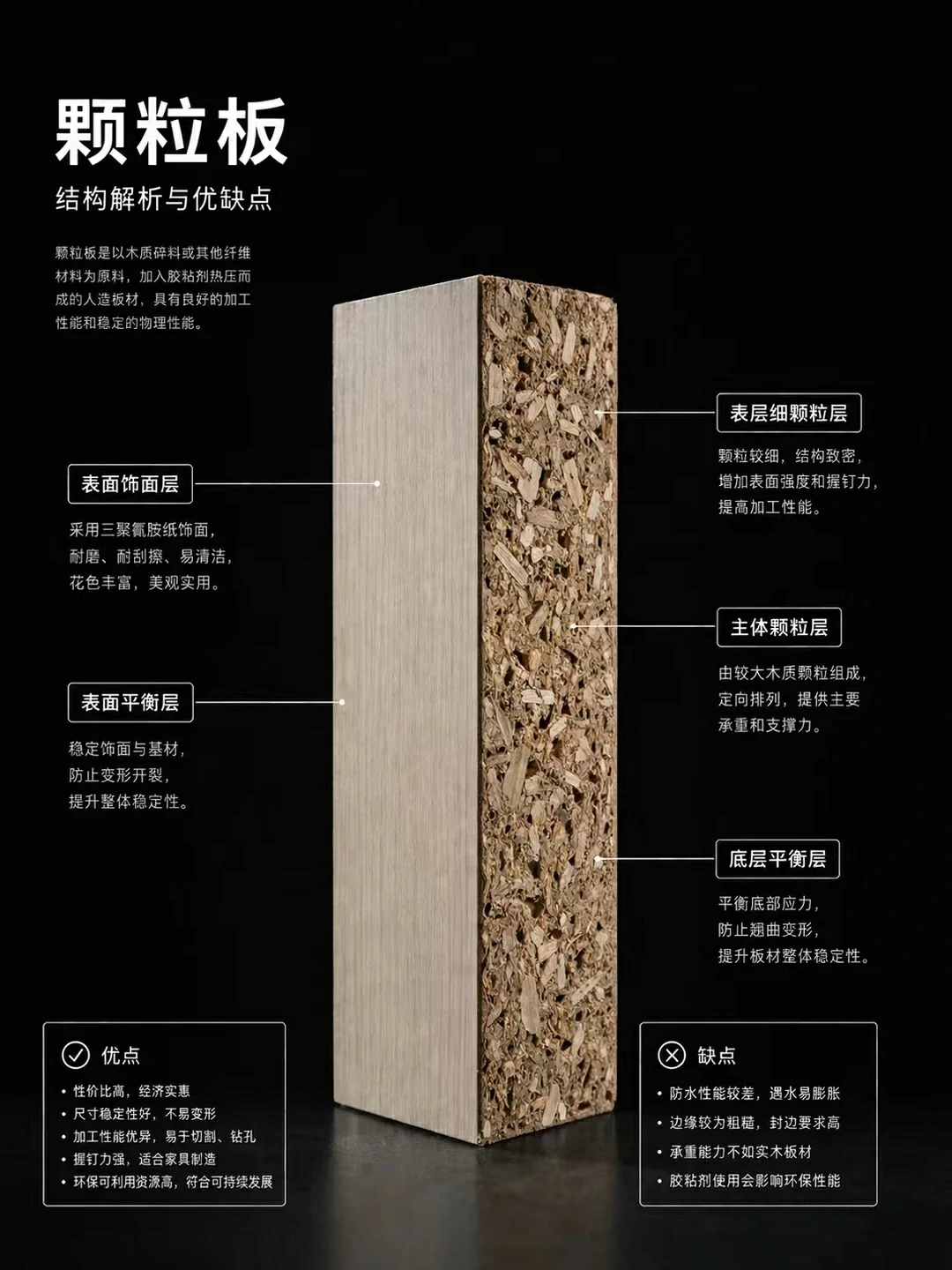
Same Particle Board, Double Price? Real Shot Comparison
In whole-house customization, most homeowners are confused: They are all particle boards, why is the price doubled? Where is the hidden gap?
Most low-price routines rely on information difference. Homeowners only see the name “particle board” but ignore core differences in materials, glue, finishing and craftsmanship.
Through real shot detailed comparison, I will fully reveal why the same-named particle boards have completely different quality, durability and environmental performance.
1. Raw Material Difference: Waste Chips vs Pure Wood Chips
Low-cost particle boards are made of recycled miscellaneous wood, bark, waste fragments and leftover materials. The internal density is uneven with hollow gaps, causing moisture swelling, cracking and deformation in daily use.
High-quality particle boards adopt pure virgin wood slices and are produced by imported continuous pressing production lines. The structure is uniform, stable and low in internal stress, perfectly suitable for full-height tall doors without warping.
In short: cheap boards are compressed waste, while high-end boards are restructured solid wood.
2. Glue Difference: Urea-Formaldehyde Glue vs MDI Formaldehyde-Free Glue
This is the biggest invisible gap in environmental protection and price.
Low-grade boards use cheap urea-formaldehyde glue with high formaldehyde content. Odor rebounds in high temperature and humid weather, with a release cycle of more than ten years.
Premium ENF-grade particle boards adopt medical-grade MDI formaldehyde-free glue. Zero formaldehyde emission, zero peculiar smell, stronger adhesion and better moisture resistance, ensuring safe immediate move-in.
3. Surface Finishing Difference: Ordinary Paper vs Imported Synchronized Texture
Boards may look identical in color, but the texture gap is huge.
Low-cost boards use thin domestic color paper with blurry patterns, easy yellowing, fading and scratching within several years.
High-quality boards adopt thick imported decorative paper and synchronized embossing technology. The texture is three-dimensional, wear-resistant, UV-resistant and scratch-proof, maintaining a brand-new appearance for more than ten years.
4. Edge Sealing Difference: EVA Sealing vs PUR/Laser Seamless Sealing
Edge sealing determines the service life of cabinets.
Low-price matching EVA sealing has thick glue lines and obvious gaps, leading to glue peeling, moisture penetration, mold and continuous formaldehyde leakage.
Premium customized boards adopt PUR hot melt or laser seamless edge sealing. Zero glue lines, zero gaps, fully locking moisture and harmful gas for long-term durability.
5. Hardware & After-Sales Gap
Low-price packages are equipped with inferior miscellaneous hardware, easy to rust, sag and get stuck with no warranty.
High-end customization comes with branded damping hardware, silent opening and closing, strong load-bearing capacity and reliable factory after-sales service.
Industry Truth
The double price difference of particle boards is completely reasonable.
Cheap boards only have the same name, while high-quality boards have superior stability, environmental protection and durability.
Low-cost customization saves money temporarily but sacrifices family health and long-term living experience. High-quality customization charges more for better materials, craftsmanship and safety.
Never compare quotations only by board names. Raw materials, glue grade, surface technology and edge sealing quality determine the real value of custom cabinets.
If you are comparing customization quotations and want to identify board quality and avoid low-price traps, book our free quotation inspection service. We help you select cost-effective and trap-free whole-house customization solutions.