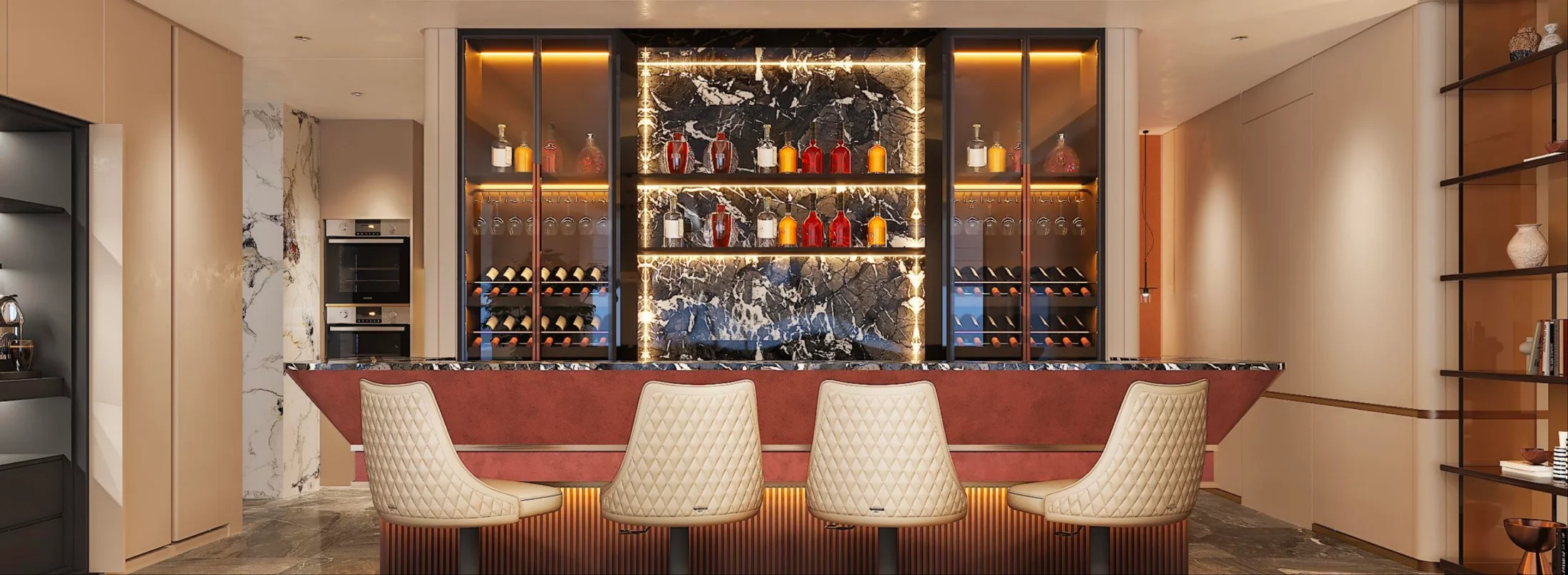
You can spend a fortune on premium countertops, imported hardware, and designer finishes - and still end up with a kitchen that's frustrating to cook in. Because the single biggest factor in kitchen satisfaction isn't materials or aesthetics. It's layout. Get the spatial relationships wrong, and no amount of beautiful surfaces can compensate for a workflow that fights you every time you prepare a meal.
After designing hundreds of custom kitchens at BITY, we've seen the same layout mistakes repeated across projects worldwide. Some are inherited from the original architecture. Some are introduced by designers who prioritize appearance over function. And some are simply the result of not thinking carefully enough about how a kitchen actually gets used.
Here are the five most common layout mistakes - and how thoughtful custom design prevents them.
Mistake #1: Ignoring the Work Triangle
The work triangle - the spatial relationship between the refrigerator, the sink, and the cooktop - has been a foundational principle of kitchen design for decades. And for good reason: these three stations are the most frequently used during meal preparation, and the distances between them directly affect how much walking, reaching, and turning you do while cooking.
The classic guideline suggests that each leg of the triangle should be between 1.2 and 2.7 meters, and the total perimeter should be between 4 and 8 meters. Too compact, and you're cramped. Too spread out, and you're exhausted from walking back and forth.
The mistake we see most often isn't that people don't know about the work triangle - it's that they sacrifice it for other priorities. They want the refrigerator in a specific corner for aesthetic reasons, or they insist on a cooktop location that looks great in the rendering but puts it 4 meters from the sink. The result is a kitchen that photographs beautifully but tires you out during a 30-minute cooking session.
The custom solution: When BITY designs a kitchen, the work triangle is established first, before any aesthetic decisions are made. We map the optimal positions for the three key stations based on the room's dimensions and the client's cooking habits (a serious home chef has different workflow needs than someone who primarily reheats and assembles). Only after the functional layout is locked do we layer on the design elements. This sequence - function first, beauty second - is the difference between a kitchen that works and one that merely looks good.
Mistake #2: Insufficient Counter Space
Counter space is the most precious commodity in any kitchen, and it's chronically underestimated. People focus on cabinet storage (important) and appliance placement (also important) but forget that you need clear, unobstructed counter surface to actually prepare food.
The minimum recommendation is at least one continuous stretch of counter at least 90 centimeters wide for food preparation. Ideally, you want clear counter space on both sides of the cooktop (for staging ingredients and plating) and beside the sink (for drying and prep). In practice, many kitchens end up with counters that are technically present but functionally useless because they're interrupted by appliances, cluttered with permanent fixtures, or too narrow to work on comfortably.
The custom solution: Custom kitchen design allows us to optimize counter space in ways that standard kitchens can't. We can specify exact counter depths (not locked into standard 60cm depth), create extended counter sections where the workflow demands it, and integrate appliances below the counter surface (embedded ovens, dishwashers, and even cooktops) to keep the counter clear. For kitchens with island counters, the island becomes a dedicated preparation surface - often the most used workspace in the entire kitchen.
Mistake #3: Poor Storage Zoning
A kitchen with plenty of cabinet space but poor storage zoning is almost as frustrating as a kitchen with too little storage. Zoning means organizing storage so that items are located near where they're used: pots and pans near the cooktop, cutting boards and knives near the prep area, dishes and glasses near the dishwasher or drying area, cleaning supplies under the sink.
The mistake happens when cabinets are designed as generic boxes without considering what will go in them and where those items are needed. You end up storing heavy pots in an upper cabinet across the room from the stove, or keeping everyday dishes in a hard-to-reach corner cabinet while prime real estate holds rarely used serving platters.
The custom solution: BITY's kitchen design process includes a detailed storage planning phase where we discuss with the client what they own, what they use daily versus occasionally, and how they prefer to organize. We then design each cabinet, drawer, and shelf for its specific contents. Deep drawers near the cooktop for pots and pans. Shallow drawers with dividers near the prep area for utensils and tools. Pull-out pantry systems for dry goods. Dedicated recycling and waste sorting integrated into the cabinet system. This level of specificity is only possible with custom design - and it transforms daily kitchen use from a series of small frustrations into a smooth, intuitive workflow.
Mistake #4: Neglecting Lighting
Kitchen lighting is often treated as an afterthought - a single ceiling fixture selected during the final stages of construction. This is a serious mistake, because inadequate lighting makes food preparation harder, less safe, and less enjoyable.
The most common lighting failure is relying solely on overhead ambient lighting, which creates shadows on the counter surface exactly where you're trying to work. When you stand at the counter, your body blocks the overhead light, casting your work area in shadow. This is particularly problematic for tasks that require visual precision - chopping vegetables, reading recipes, checking whether meat is properly cooked.
The custom solution: Integrated under-cabinet lighting is the single most impactful lighting upgrade in any kitchen. LED strips mounted beneath upper cabinets illuminate the counter surface directly, eliminating shadows and providing bright, even task lighting exactly where it's needed. At BITY, we design lighting integration into the cabinet system from the start - the wiring channels, switch locations, and LED strip positions are all planned during the design phase, not retrofitted after installation.
Beyond task lighting, we also consider ambient lighting (overall room illumination), accent lighting (highlighting design features like glass-fronted cabinets or open shelving), and mood lighting (dimmable options for when the kitchen transitions from workspace to social space). A well-lit kitchen is a pleasure to work in; a poorly lit kitchen is a daily annoyance.
Mistake #5: Choosing the Wrong Layout for the Room
This is the meta-mistake that encompasses all the others: selecting a kitchen layout that doesn't suit the room's dimensions, the household's cooking patterns, or the home's social dynamics.
The four primary kitchen layouts each have optimal applications:
L-shaped layouts work well in medium-sized kitchens and open-plan spaces where the kitchen shares the room with dining or living areas. They provide good work triangle geometry and leave one side of the kitchen open for traffic flow and social interaction.
U-shaped layouts maximize storage and counter space in dedicated kitchen rooms. They're ideal for serious cooks who want everything within arm's reach. However, they can feel enclosed in smaller rooms and don't naturally accommodate social cooking (it's hard for others to participate when the cook is surrounded by cabinets on three sides).
Double straight (galley) layouts are efficient for narrow rooms and can create excellent work triangle geometry with minimal walking distance. They're popular in professional kitchens for a reason - the parallel counter arrangement keeps everything close. The limitation is that they don't easily accommodate an island or social seating.
Island layouts are the most versatile and currently the most popular for luxury kitchens. The island provides additional counter space, storage, seating, and a natural gathering point for social cooking. However, islands require sufficient room - a minimum of about 1 meter of clearance on all sides - and poorly sized islands can obstruct traffic flow rather than enhance it.
The custom solution: At BITY, layout selection is a collaborative process. We analyze the room dimensions, discuss the client's cooking habits and social preferences, consider the relationship between the kitchen and adjacent spaces, and then recommend the layout that best serves all of these factors. Sometimes the right answer is obvious; sometimes we present two or three options with honest assessments of each one's trade-offs.
The critical advantage of custom design is that we're not constrained by standard cabinet module sizes. If the optimal island width for your kitchen is 1.35 meters - not the standard 1.2 or 1.5 - we build it at 1.35 meters. If the best U-shaped layout requires one arm to be 15 centimeters deeper than the other to accommodate a structural column, we design it that way. This flexibility to adapt to the room's reality, rather than forcing the room to accommodate standard dimensions, is what makes custom kitchen design genuinely superior to modular alternatives.
The Bigger Picture
All five of these mistakes share a common root cause: designing the kitchen based on how it looks rather than how it works. The most successful kitchen designs start with workflow analysis, proceed through spatial optimization, and only then address aesthetics - which, when built on a solid functional foundation, tend to fall into place naturally.
A kitchen that works beautifully is a kitchen that looks beautiful in the most meaningful sense: it looks like a space where real cooking happens with ease and pleasure. And that's a kind of beauty that no amount of surface decoration can fake.
If you're planning a kitchen project, start by thinking about how you cook. The design will follow.
The BITY Kitchen Design Philosophy
At BITY, our kitchen design process is built around a simple conviction: a kitchen should be designed from the inside out. We start with how you cook, what you store, and how you move through the space. We build the functional framework first - work triangle, counter zones, storage plan, lighting scheme. Only then do we apply the aesthetic layer - materials, colors, finishes, hardware.
This approach produces kitchens that are genuinely pleasurable to use, not just pleasant to look at. And because the aesthetic decisions are made within a functional framework, they tend to be better aesthetic decisions too. When the layout is right, the proportions are right, and the storage is right, the kitchen has an inherent visual harmony that comes from things being where they belong.
Our manufacturing capabilities support this philosophy. Because we produce custom components on automated CNC lines, we're not constrained by standard module sizes. Every dimension can be optimized for the specific space and the specific use case. This flexibility is the fundamental advantage of custom kitchen design over modular systems, and it's what allows us to solve the layout problems that standard kitchens can't address.
We also integrate our kitchen designs with the broader
whole-house customization project. The kitchen's material palette connects to the wardrobes, bathroom vanities, and other custom elements throughout the home. Hardware styles are consistent. Design language is unified. The kitchen doesn't exist in isolation - it's part of a coherent living environment that feels intentionally designed from room to room.
For clients who are serious about cooking - and about living well - a custom kitchen designed around actual workflow needs is one of the most rewarding investments you can make in your home. Every meal you prepare in a well-designed kitchen reinforces the value of that investment. And over the years, as you develop new recipes, host countless dinners, and share thousands of meals with family and friends, the kitchen becomes more than a room. It becomes the heart of your home's story.
Don't let layout mistakes write that story for you. Design it intentionally, build it precisely, and cook in it joyfully.