Many homeowners think whole-house customization is just buying boards and hardware. Once you start shopping, you will quickly find this industry is full of information asymmetry. The beautiful renderings and attractive showroom samples cannot fully reflect what you will actually receive. Let’s break down how deep these hidden pitfalls really are.
1. Material substitution is hard for ordinary people to detect
Sales may promise ENF-grade branded panels for the whole cabinet. But some merchants only use qualified premium boards for visible cabinet doors, while using cheaper, lower-grade boards for carcasses, back panels and hidden partitions.
The texture and color look almost identical after veneering. Without anti-counterfeit codes and inspection reports, homeowners can barely tell the difference after installation. Some even replace branded refined boards with generic plain boards to cut costs.
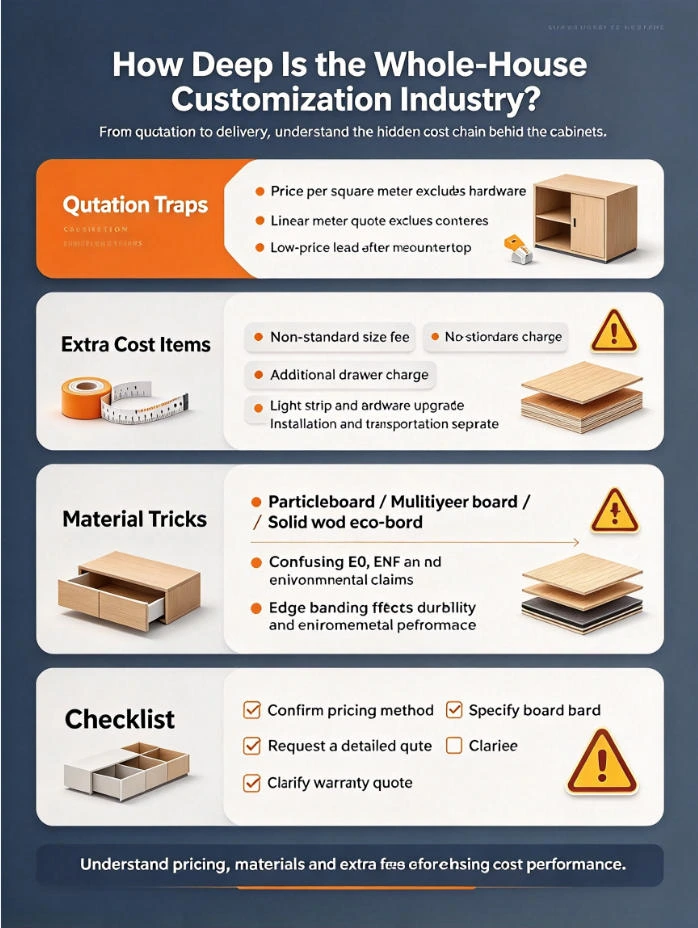
Merchants advertise low per-square-meter prices to attract enquiries. The base price only covers the simplest cabinet carcass. Drawers, pull-out baskets, glass doors, light strips, filler strips, corner fittings and reinforcement plates are all charged separately.
Many customers only see the full added cost after design confirmation. Their budget can easily jump by 20%–40%. All these extra items are not clearly marked in the initial quotation.
3. Craftsmanship cutting corners is invisible at first glance
Edge banding is a typical example. You may pay extra for PUR edge sealing, but the factory only applies PUR glue on front visible edges, and uses cheap EVA glue on the back and hidden edges. EVA glue will bubble and peel in humid environments over time.
Similarly, rough CNC cutting, inaccurate hinge hole drilling and thin back panels can all reduce cabinet durability. These flaws are not obvious at the time of handover and only show up months later.
Sales frequently promote “zero formaldehyde” slogans. In fact, even ENF grade only applies to the panel substrate. Glue, edge banding adhesive and assembly accessories still release trace formaldehyde.
A cabinet made of ENF boards can still have poor indoor air quality if edge banding is poorly done. Many merchants only provide test reports from sampled lab boards instead of real batch inspection reports for your actual order.
5. Hardware markup and false imported branding
Hardware is another profit hotspot. Basic hardware included in cheap packages is low-end and wears out quickly. When customers want smoother soft-close performance, sales push expensive imported hardware.
Some so-called imported hardware is counterfeit or generic parts packaged with foreign brand labels. Reliable domestic hardware can reach the same opening cycle standard at a much lower price.
6. Empty after-sales promises that vanish when problems happen
Many small shops promise lifetime warranty. But their business may close within a couple of years. Once the store shuts down, your deposit, unfinished cabinets and warranty all become unprotected.
Even for big brand franchise stores, brand headquarters and franchisees often pass the buck when faults occur. The verbal warranty commitment cannot be enforced without clear written terms.
How to Protect Yourself From These Industry Pitfalls
- Write panel brand, grade, hardware model and edge banding standard into the contract item by item.
- Request a fully itemized quotation listing all optional items and unit prices.
- Retain sample boards, quotation sheets, communication records and inspection reports.
- Control payment progress and avoid paying large deposits before production.
- Confirm warranty scope, after-sales response rules and liability for delays.
Final Thoughts
The industry is not all bad. Many reliable manufacturers focus on stable quality and honest communication. The “deep water” mainly comes from information asymmetry and merchants chasing quick profits by cutting corners.
Understanding these hidden traps does not mean you should give up custom cabinets. It helps you stay rational and evaluate suppliers by verifiable standards rather than marketing slogans.
If you are planning whole-house custom cabinets, book our free on-site measurement service. We list all material and workmanship specifications clearly in the contract with hidden fees.