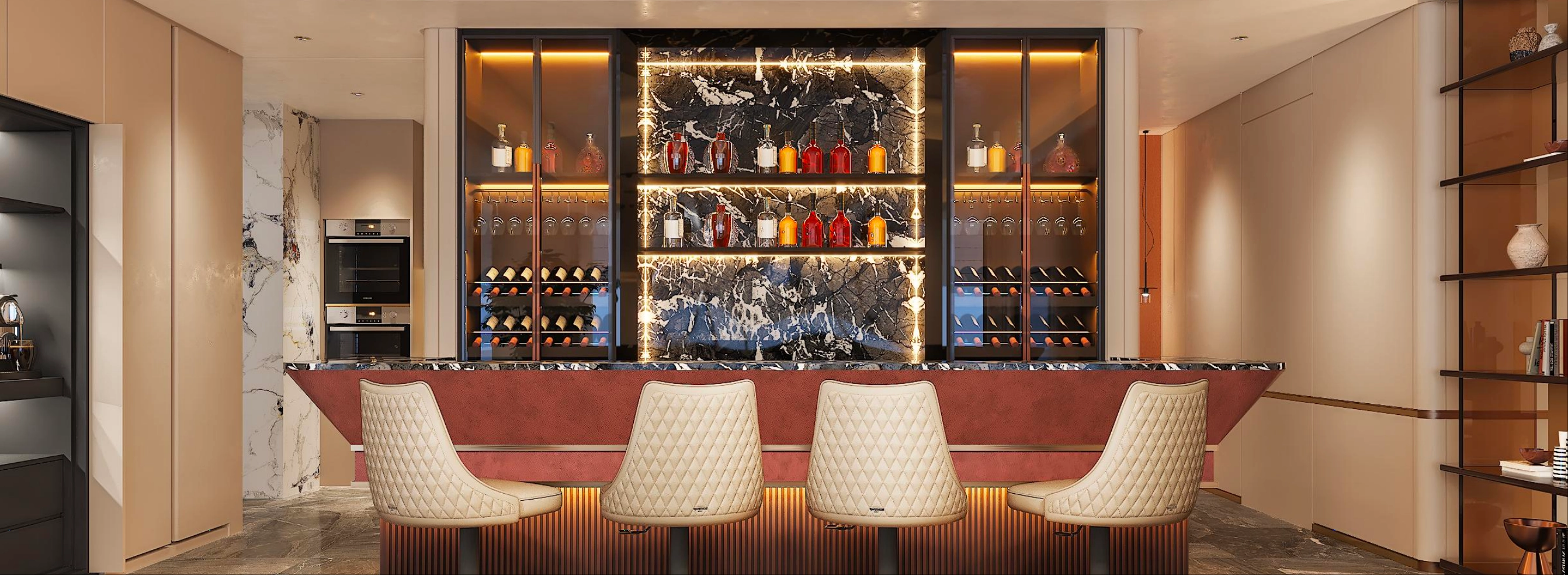
A villa in the suburbs and a penthouse apartment in the city center might both qualify as "luxury homes," but they present fundamentally different design challenges. The spatial characteristics, structural constraints, lifestyle patterns, and aesthetic opportunities of each property type demand distinct approaches to whole-house customization. Treating them the same is a recipe for missed potential.
At BITY, we work across the full spectrum of residential property types - from sprawling single-family villas to compact high-end apartments. This experience has taught us that the best custom furniture solutions aren't just about beautiful design; they're about design that's precisely calibrated to the property type and the lifestyle it supports.
Understanding the Fundamental Differences
Before diving into specific design strategies, it's worth articulating what makes villas and apartments fundamentally different from a customization perspective.
Space abundance vs. space efficiency. Villas typically offer generous room dimensions, high ceilings, and multiple rooms dedicated to specific functions. The design challenge is creating coherence and warmth across large spaces without them feeling empty or disconnected. Apartments, even luxury ones, require more disciplined space utilization - every square meter needs to earn its place, and multi-functional solutions become more important.
Architectural character. Villas often have distinctive architectural features - exposed beams, irregular room shapes, multiple levels, indoor-outdoor transitions - that custom furniture needs to complement and work around. Apartments tend toward more standardized geometries with consistent ceiling heights and regular room shapes, which simplifies furniture design but also means the furniture itself needs to provide more of the visual interest.
Indoor-outdoor relationship. Villas typically have significant outdoor spaces - gardens, courtyards, terraces, rooftops - that create opportunities for integrated indoor-outdoor design. Apartments may have balconies or terraces, but the indoor-outdoor relationship is generally more limited.
Privacy and noise. Villa residents don't share walls with neighbors, which affects material choices (less concern about sound transmission) and design freedom (no restrictions from building management on modifications). Apartment residents may face building regulations that limit structural modifications and need to consider acoustic performance.
Villa Customization: Embracing Scale and Integration
Villa projects are where whole-house customization truly comes into its own, because the scale and complexity of the space demand a unified design vision that standalone furniture simply can't provide.
The Whole-House Design Language
In a villa, the custom furniture isn't just furnishing rooms - it's establishing the design language of the entire home. The material palette, color scheme, hardware style, and proportional relationships established in the kitchen should echo through the wardrobes, bathroom vanities, and living room built-ins. This doesn't mean everything looks the same; it means everything feels related, like chapters in the same book.
At BITY, villa projects begin with a design concept that spans the entire home. We establish a core material and color palette, then develop room-specific designs that express that palette in ways appropriate to each space's function and character. The kitchen might emphasize the palette's stone and metal elements, while the bedroom wardrobes emphasize its wood and textile qualities - different expressions of the same design DNA.
Leveraging Ceiling Height
Villas frequently have ceiling heights of 3 meters or more - sometimes significantly more in double-height spaces. This vertical dimension is an opportunity that standard furniture can't exploit. Custom wardrobes can extend to the ceiling, providing dramatically more storage than standard-height units while creating a built-in, architectural quality that transforms the room.
Floor-to-ceiling cabinetry in kitchens, full-height bathroom vanity mirrors, and tall entrance hall storage units all take advantage of villa ceiling heights to maximize both function and visual impact.
Multi-Room Coordination
A typical villa customization project might include: master bedroom wardrobe and dressing room, 2-4 secondary bedroom wardrobes, kitchen cabinets with island, 2-4 bathroom vanities and storage systems, entrance hall cabinetry, living room built-in shelving or media units, laundry room storage, and potentially a home office or library. Coordinating all of these elements into a coherent whole is a significant design and project management challenge - and it's where the value of working with a single manufacturer becomes most apparent.
Indoor-Outdoor Integration
For villas with gardens, courtyards, or rooftop terraces, the customization scope can extend beyond the interior. At BITY, our infinity pool offering is specifically designed to integrate with villa architecture, creating seamless transitions between indoor living spaces and outdoor leisure areas. The pool deck materials can echo interior flooring, the pool's geometric form can align with the home's architectural lines, and the surrounding landscape design can be coordinated with the interior design palette.
Apartment Customization: Maximizing Every Square Meter
Apartment customization is a different discipline - one that rewards ingenuity, precision, and a deep understanding of how people actually use compact spaces.
Storage as Architecture
In apartments, storage isn't just a feature of the furniture - it's the primary reason for custom furniture. The difference between a well-organized apartment and a cluttered one often comes down to whether the storage solutions were designed for the specific space and the specific resident's needs.
Custom wardrobes in apartments need to be ruthlessly efficient. Every shelf height should be optimized for what it will hold. Drawer dividers should be configured for the resident's actual clothing and accessories. Hanging sections should be sized for the resident's actual wardrobe - not a generic average. This level of personalization is only possible with true customization.
Multi-Functional Design
Apartment living often requires furniture to serve multiple purposes. A kitchen island that doubles as a dining table. A wardrobe system that incorporates a fold-down desk. A bathroom vanity with integrated laundry hamper storage. These multi-functional solutions require careful engineering to work well - they need to be genuinely useful in each function, not awkward compromises that don't fully satisfy any purpose.
Visual Space Expansion
In apartments, the perceived size of a room is as important as its actual size. Custom furniture can significantly influence spatial perception through several strategies:
Wall-mounted furniture (vanities, bedside tables, media units) creates visible floor space beneath, making rooms feel larger. Light-colored finishes reflect more light and recede visually. Glass and mirror elements add depth. Consistent material and color choices across rooms create visual flow that makes the apartment feel more spacious than it is.
Conversely, dark colors, heavy visual weight, and inconsistent design between rooms can make even a generous apartment feel cramped and disjointed.
Precision Matters More
In a villa, a 2-centimeter gap between a wardrobe and the wall is barely noticeable. In an apartment bedroom, where the wardrobe might occupy an entire wall and the room is viewed from close range, that same gap is conspicuous. Apartment customization demands tighter tolerances and more precise measurement because the viewing distances are shorter and the spatial relationships are more intimate.
Style Considerations by Property Type
While personal taste ultimately drives style choices, certain design directions tend to work better in different property types:
Villas can support bolder, more dramatic design statements - dark color palettes, large-scale patterns, statement materials like book-matched stone slabs. The generous spaces provide enough visual breathing room for strong design elements without overwhelming the room.
Apartments generally benefit from lighter, more restrained design approaches. Modern light luxury and Nordic simple styles work particularly well because they combine visual sophistication with the spatial lightness that compact spaces need. This doesn't mean apartments can't have personality - it means the personality is expressed through refined details rather than grand gestures.
New Chinese style can work beautifully in both contexts but requires different scaling. In a villa, the symmetry and formality of new Chinese design can be expressed at full scale - a grand entrance hall with balanced cabinetry, a formal dining room with traditional proportional relationships. In an apartment, the same design principles are applied at a more intimate scale, with cultural references expressed through material choices and subtle details rather than spatial grandeur.
Budget Allocation Strategies
How you allocate your customization budget should also differ by property type.
For villas, we typically recommend investing heavily in the kitchen and master suite (bedroom + bathroom), as these are the spaces where you spend the most time and where quality has the greatest daily impact. Secondary bedrooms and utility spaces can use the same design language with more cost-effective material selections.
For apartments, the kitchen often represents the single largest customization investment because it's typically the most complex space with the most components. Wardrobes are the second priority, followed by bathroom vanities. In open-plan apartments, the kitchen is also the most visible element of the custom furniture, making it the design centerpiece of the home.
The Common Thread
Despite their differences, villa and apartment customization share one fundamental principle: the best results come from understanding the specific space, the specific resident, and the specific lifestyle that the furniture needs to support. Generic solutions - whether generic "luxury" for villas or generic "space-saving" for apartments - miss the point of customization entirely.
The whole point is that it's custom. Designed for this space. Built for this person. Tailored to this life. Whether that life unfolds in a hillside villa with ocean views or a city-center apartment with skyline panoramas, the furniture should feel like it couldn't possibly belong anywhere else.
That's the standard we hold ourselves to at BITY, regardless of property type. And it's the standard you should expect from any manufacturer you choose to work with.
Project Management: The Hidden Differentiator
Whether you're customizing a villa or an apartment, the quality of project management often determines the quality of the outcome more than any single design or material decision. A beautifully designed project that's poorly managed - with missed deadlines, communication gaps, and coordination failures - will be a frustrating experience regardless of how good the furniture looks when it's finally installed.
For villa projects, the project management challenge is scale. Coordinating the design, production, and installation of furniture across 10-15 rooms, potentially including an infinity pool, requires meticulous planning and proactive communication. At BITY, villa projects are assigned dedicated project managers who maintain a master timeline, coordinate between design, production, and installation teams, and serve as the client's single point of contact throughout the process.
For apartment projects, the challenge is often coordination with other trades. In a renovation scenario, the custom furniture installation needs to be sequenced with flooring, painting, plumbing, electrical, and other work. Getting this sequence wrong can result in damage to finished surfaces, installation delays, and costly rework. Our project managers work with the client's general contractor (if applicable) to establish a realistic installation schedule that accounts for all dependencies.
Communication cadence matters too. We provide regular progress updates at key milestones - design approval, production start, production completion, shipping, and installation scheduling. For international projects, we also provide shipping tracking information and customs clearance status updates. The goal is to keep clients informed without overwhelming them with unnecessary detail.
Final Thoughts on Choosing Your Approach
The decision between villa and apartment customization isn't really a choice - it's determined by your property. But within each category, there are meaningful choices to make about scope, materials, style, and budget allocation. The most important thing is to work with a manufacturer who understands the specific requirements of your property type and can adapt their approach accordingly.
A manufacturer who treats every project the same - applying villa-scale thinking to apartment spaces, or apartment-efficiency thinking to villa projects - will miss opportunities and create compromises. The best results come from a team that recognizes the unique characteristics of each property and designs specifically for them.
At BITY, we've built our capabilities around this principle of adaptive design. Whether your project is a 500-square-meter villa with an infinity pool or a 120-square-meter apartment that needs every centimeter optimized, we bring the same commitment to quality, the same attention to detail, and the same dedication to creating spaces that feel perfectly, unmistakably yours. 
 Individuelles Design. Fabrikgefertigt. Weltweit geliefert BITY FULL HOUSE FACTORY